Saturday, 26 November 2011

I'm Henry the 8th, I am, I am!

Ok, so apparently, people have actually noticed that I have been totally slack with these posts. Admittedly, when I say people, I mean my Mum, but hell, an audience is an audience! Its just that time seems to fly by when your stressing about how much work you have to do in such a short period of time! But a little bit of stress is a great motivator, and now I have a clear idea of topics for my dissertation, which is awesome!

Enough about work! More about London adventures! The other weekend, I went to Hampton Court for the day, it was AMAZING. So much stuff to see and so little time! There are three main parts to the palace: the Tudor part, the part for William and Mary, and the Georgian part. So, because there is so much to say and I took so many photos, I am going to break down the Hampton Court excitement into three posts.

First, and probably most importantly, the Tudors.

Check out the fountain - apparently on special occasions, it would run with wine instead of water!

The palace was actually built (in this amazing red brick) in 1514 by Cardinal Wolsey, Henry the eight's closest advisor and the most powerful man in England. The whole place was designed to impress the numerous foreign dignitaries that Cardinal Wolsey entertained - in the main courtyard (in the photo above), all the upper rooms were specially designed as guest accommodation and all the rooms had their own toilets which drained out under the courtyard and into the Thames nearby. Not having to share a toilet was beyond impressive at the time.

However Wolsey made a fatal error in making the palace so amazing, Henry fell in love with it, and Wolsey had to give the palace to Henry as a "gift". Poor old Wolsey. Especially as he later fell out of favour with Henry because he couldn't organise Henry's divorce from Catherine of Aragon, and died in the Tower of London. There are rumours he committed suicide, but he was probably just sick.

There's ole Wolsey right at the top, above Henry. Interesting!
So, on to Henry, probably the most famous, and infamous, king in English history. He's pretty much remembered as a fat, gouty old man with a gammy leg. But when he first game to power, he was young, handsome, energetic and charismatic. He hunted and jousted, and was intelligent and funny. He was Johnathan Rhys Meyers. It was during his youth that Henry ruled with the help of Wolsey and his then wife, Catherine of Aragon. Even though Henry got fat and gouty later on, he never lost his charisma - he was the sort of person that people were drawn to and were excited to be in his presence. The fact that he was the King of England probably helped with that, but he was undoubtedly an attractively personality.

Look at him there, luring you in with his eyes.

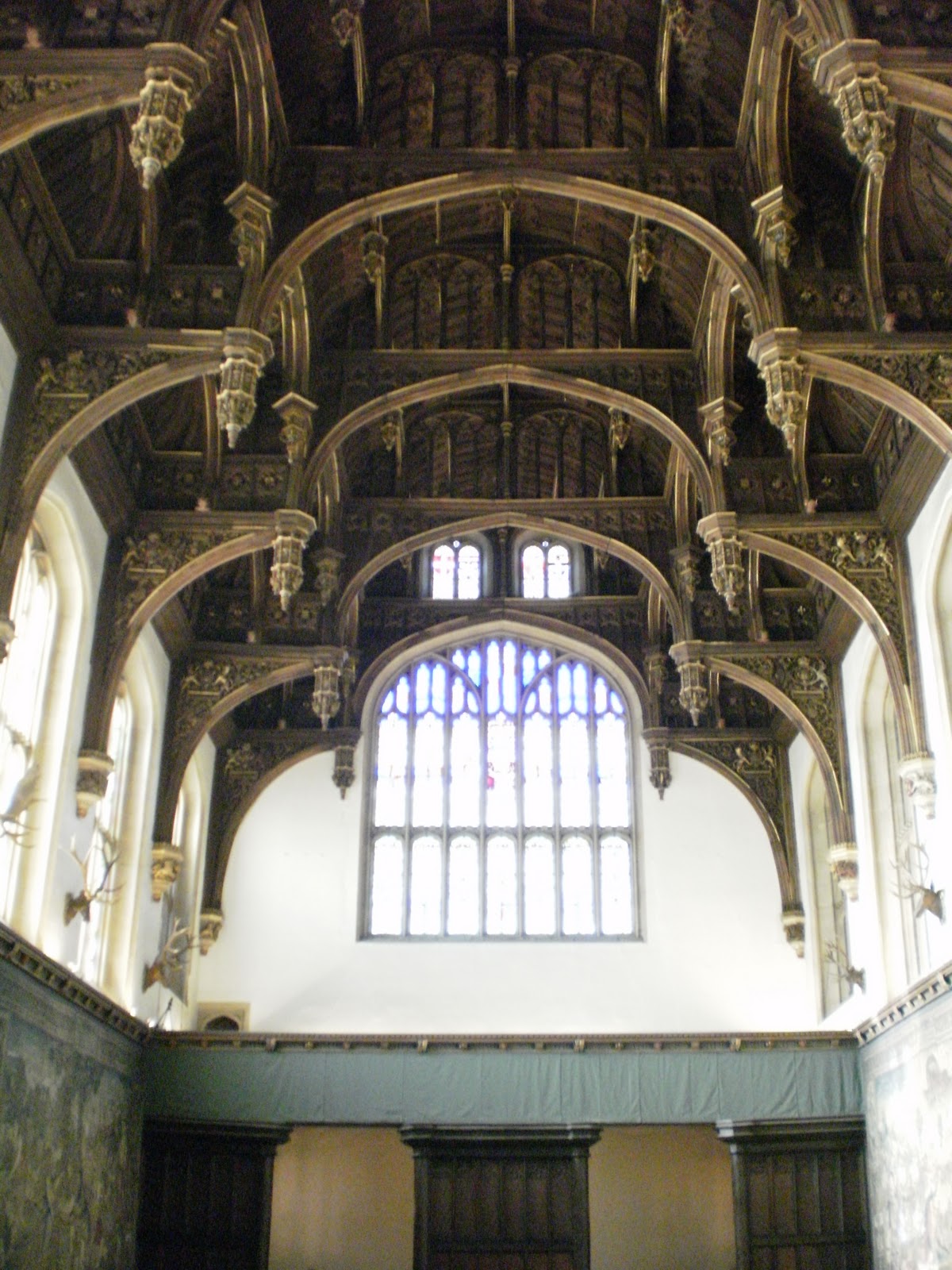
So Henry got rid of Catherine, and replaced her with Anne Boleyn, then Jane Seymour, the Anne of Cleaves, then Catherine Howard and then Katherine Parr. Throughout this time, Hampton Court was still being added to, and different rooms have little pieces of each queen's iconography hidden everywhere. All trace of Anne Boleyn was supposed to have been removed, but some were missed. You can't really see it in the photo below, but on the far right hand side of the balcony, there is an A and H intertwined. But also, check out the ceiling! This is the banqueting hall, and you really have to see it to get how amazing it really is (especially as my photography skills aren't exactly the greatest).

My friend Samantha taught me a little poem to help remember the fate of all of Henry's wives: "Divorced, beheaded, died; divorced, beheaded, survived"! Out of all those wives, Henry got only three children: Mary, Elizabeth and Edward.

Here they all are: Edward standing on the left of Henry and Elizabeth on the right, with Mary on the far right. The women on the far left is probably Jane Seymour, Henry's favourite wife, even though she was dead by this time.
Although the youngest, Edward was the first on the throne, being the only, and much desired, son. Although he looked a lot like his father, he didn't have his father's strength, either of personality or physically. Edward was the son of Jane Seymour, who was Henry's most treasured wife because she gave him a son, and probably because she wasn't as aggravating as the previous two. After Jane died giving birth to Edward, Henry kept a lock of her hair in his bible until he died, and was buried next to her in St George's Chapel.

Edward only ruled England very briefly, and even then he ruled under the advice of a council because he was too young to rule alone. He died at the age of 15, probably of tuberculosis or pneumonia. In his will, he gave his throne to his cousin the Lady Jane Grey, ignoring his father's will. However, Mary was quick to depose Jane and take her place.


Mary, the eldest, was the daughter of Catherine of Aragon, and like her mother, a devout Catholic. She wasn't a particularly nice person - a lot of people where burned as heretics during her reign as queen. Her hardline approach was probably due to her relationship with her parents. Initially, both her parents were devoted to Mary and took a great interest in her education, particularly her mother. But when Catherine refused to divorce Henry, as punishment, Henry sent Mary away from her mother(using a child to inflict pain on an ex-wife! And they say history never repeats), and consequently, Mary greatly resented her father.

Mary married Philip of Spain, who was a bit of a weedy bloke and not much liked by the English public, but apparently they had quite a happy marriage. Mary became queen in 1553, after a little confusion with the Lady Jane Grey's appointment as a puppet queen. She ruled until 1558, aggressively pushing Catholicism and putting down Protestantism, until she died, probably, of ovarian cancer. Despite her negative legacy (she was commonly known as Bloody Mary, especially in Protestant Circles), she was a trailblazer, being the first woman to successfully claim the throne of England.

This is the clock gateway in Clock Court. The clock is amazing - it tells the time, the month, and the relevant sign of the zodiac. Also, check out the chimneys - Hampton Court is famous for these.
After Mary died, Elizabeth took the throne. Elizabeth was the daughter of the infamous Anne Boleyn and Henry, and seemed to unite some of the best qualities of both her parents - she was intelligent, strong, independent, and charismatic - and was probably the most like her father out of all her siblings. She was one of England's longest rulers (after Queen Victoria) and also one of the best. Under her rule, the British Empire was founded, which would eventually make England the most powerful nation in the world. She never married, believing that she had the ability to run the country alone. Books have been written about her, movies have been made about her (Cate Blanchet is probably my favourite), all in all, she was a pretty amazing woman.

The entrance to Hampton Court.

Ok, enough about people, let's get on to the important stuff - food!

Henry's court was made up of over 600 people, and they toured around the country, visiting all of Henry's palaces. This was partly for political reasons but also because the court sucked the surrounding countryside dry. Hampton Court has MASSIVE kitchens, designed to store and cook all the food that such a huge court required. The court ate a lot of meat, because meat was expensive and to be able to serve a lot of it showed how wealthy you were. This was also why all of the workers in Henry's kitchens were men - men were more expensive to hire. If you go to Hampton Court on the right days, there are experiemental chefs in the kitchens, cooking exactly the same way as they did in Tudor times.

Here's a wee photo, just to give you an idea about the scale of these kitchens - this is only one of the open fires, and its big enough to stand up in:


On that note, its time for dinner - more on Hampton Court soon!

Saturday, 12 November 2011

This Little Piggy Went to Market

Sorry for such a long break between posts, I know that you have all been hanging out for the next installment (humour me). I've had a cold and been trying to write an essay this week, so my time has not really been my own. But here we are now, all listening attentively? Good, then lets begin!

I want to begin by announcing my biases - I freaking love markets. I love eating greasy, yet delicious, food off stands; I love all the amazing crafty stuff that people make; I love the eclectic jewellery and clothes; I love all the fake tattoos and the henna; I love that you can get your future told; I love the lights and the colours and the people. Pretty much there is nothing I dislike about them. Which means London is perfect for me - it has some of the best markets out there, with everything you could ever want or need!

So begins my attempt to systematically see all of London's markets, starting with Borough Market, next to Southwark Cathedral. Southwark Cathedral is one of London's oldest churches, having existed for over 1400 years, and it has stained glass windows depicting scenes from Shakespeare's plays (as Shakespeare lived and had his plays performed not far from the cathedral).


But now on to the main attraction: Borough Market. It is one of the oldest markets in London, having existed since the medieval period. Now it lives under the railway tracks on the South Bank, meaning that every so often trains rattle across above your head, giving it the coolest atmosphere. But the atmosphere isn't the reason that people go to Borough Market - people go to Borough Market for the food. Any possible food that you can imagine, you can find it at Borough Market.

From the standard fruits and veges:

Check out the cute little carved pumpkin - did you guess I went right before Halloween!
to flowers:

The red ones right in the middle are actually chillis! Love it - grow your own chillies!
to seafood so fresh you can almost feel the sea breeze on your face:


and the most amazingly good juices that I have ever tasted - I'm pretty addicted to old fashioned lemonade, and this was like the nectar of the gods:


But the high point is THE CAKES- so many cakes, so much sugary goodness. Words cannot describe how many cakes there were and how good they looked - so here is a picture (worth 1000 words!):


Meringues, cupcakes and macaroons.
And to make you even more jealous, here is a picture of the ones that I got to eat:


That's a Danish, coffee and chocolate cake and chocolate brownie - in hindsight, the hot chocolate may have been foolish addition, but I couldn't resist!
If I could afford to be the size of small house, I would eat nothing else but these cakes. However, seeing as I can't quite cover the cost of the cakes and a whole new wardrobe, so I had to settle with sharing so that I could taste as many cakes as possible (thanks Megan and Liz!)!

Just to conclude, I'm gonna dedicate this post to one of my bestest friends, who fostered my love of markets!!

Thursday, 3 November 2011

You're a Wizard, Harry!

The other day I went on the most exciting walk that any person can ever go on - the Harry Potter walk in London! Maybe, possibly, the Harry Potter walk in Edinburgh would be more exciting seeing as JK lived there while she wrote the first book, but she did live in London for two years before she move to Scotland, so undoubtedly some of the London essence will have snuck in there! Anyway, even the tiniest bit of Harry is enough for me!!


HARRY!
Ok, first off was the Bank of London, also known as the Old Lady of Threadneedle Street. If you check out the description of Gringotts Bank in the first book, its pretty clear why this is the beginning of the tour. Big white building, with a large door leading to hundreds of underground vaults - that's right, Bank of London = Gringotts Bank:


Are you convinced? Cause I am! Then we wandered down some of the tiny side streets that London is so famous for. These side streets are so amazing, you never know what you will find when you turn down them. In this one we found some of the pubs where Charles Dickens used to frequent, which may have been the inspiration for the Leaky Cauldron. I'm not sure how much time JK actually spent in the City (I explained the whole concept of the City in the last post) and I'm sure there are heaps of little pubs tucked away in tiny alleyways across the country, but I like the idea of the connection between JK and Charles:


Next, the very knowledgeable and interesting guide lead us to Leadenhall Market, where some of the scenes of Diagon Alley were filmed. However, they decided that the Market was too flash for Diagon Alley and they would have to do too much to make it not look like Leadenhall Market, so they cut the scenes. The most interesting thing about Leadenhall Market, apart from the fact that it looks amazing, is that it is built directly over a Roman building, probably a forum or theatre. When the market was built, people were very much aware of the Roman history in London and the value of it, but they decided to build over it anyway - the Victorians were weird people.


Here's one where its looking distinctly Diagon Alley-ish.

And now the very high point of our tour - the ENTRANCE OF THE LEAKY CAULDRON (from the first movie). Prosaically, its now an optometrists, but it was once painted black and had a curved door! We stood where Daniel Radcliffe and Robbie Coltrane (possibly) stood! The excitement was just so intense, you could almost taste it in the air. Life goal complete.


We continued on, following our dauntless tour guide, crossing the river on London Bridge. Here, I need to clear up a little issue - the bridge with the towers on it is Tower Bridge, not London Bridge. London Bridge is now pretty basic, but when it was first built it was covered with houses and shops. However, it grew too crowded and they had to tear it down and build something more functional. In fact, London Bridge has been replaced several times. For our HP purposes though, its main point of interest is that, from the bridge, you can get a good photo of where Harry and the others flew up along the Thames. Also, the funny curved building on the right is where the Muggle office workers look out and see the huge black cloud as the Death Eaters approach London.

TOWER Bridge crossing the Thames.

Finally, we arrived at our last destination - Borough Market (more on this later) and the site of Harry Potter's stay in the Leaky Cauldron. In the Prisoner of Azkaban, when Harry runs away after blowing up Aunt Marge, he stays in the Leaky Cauldron for a couple of days, in the room in the top left of this building:


Brilliant stuff! Herein ends our Harry Potter walk, may it be the first of many. I can now highly recommend checking out London Walks when you get to London - the guide was awesome, despite the fact that he asked all the small children the Harry Potter questions, not the twenty year olds who clearly had the knowledge! Those kids won so many stickers...

Friday, 28 October 2011

The 311 Steps

A couple of days ago, I climbed the Monument, and I've got the certificate to prove it! Trust me, this is an achievement - there are a lot of stairs. 311 stairs to be precise. See:


The Monument was set up to commemorate the destruction which occured during the Great Fire of London in 1666. Despite the fact that everyone knew it was going to be a bad year (1666, you see), only a couple of people died in the fire. It was the immense property damage that was the real issue, plus the fact that the parts of London which hadn't been razed to the ground were covered in ash for weeks afterward. 

However, on a positive note, Christopher Wren got a free hand in designing many of the new buildings in the City - St Pauls is one of his, as is the Monument. Here is the perfect place for a footnote - when people in London talk about going to the City, they don't just mean the city of London as a whole, but a specific place within London, namely the business district. Historically, the City refers to the part of London that was encircled by the Roman wall, and for some reason, the name has stuck. Crazy I know, but hey, I don't make the rules.


And what really makes me think that Chris W. was an all-round cool guy is that, if the Monument were to fall (eastwards, I think), the golden flames at the top would land in the exact spot that the Great Fire began - a bakery on Pudding Lane.

The other awesome thing about the Monument is that there are amazing views from the top, at a fraction of the price of the London Eye. Granted, you have to climb to the top yourself, but since climbing all those stairs will guarantee you a P. Middy style derriere, its a win-win. Here are some of my photos from the tipidy-top:


Looking up the Thames to the Tower Bridge.


The City.


So high above the ground!
Looking North (roughly)
Apart for the bad camera quality and a little smog, ENJOY!

Walk on the Wild Side

Ok, so one more tale of Kensington Palace, and one that I think is particularly interesting - the story of Peter the Wild Boy.


Peter was a boy who was found wandering alone in a forest near Hanover in 1725 - he couldn't speak, he could climb trees really fast and he survived on nuts and berries. He managed to escape once, but they managed to catch him again and were about to ship him off to an asylum when George I had him brought to London as a gift for his daughter. The court, and indeed, the whole of the country, was fascinated by this feral boy, and he was actually a huge celebrity in his time. Peter was given a tutor, but never learnt to say anything more than his own name, and was, for all intents and purposes, treated as a pet - he even had a collar with his name on it, in case he wandered off. However, he was treated well by the court, and when they eventually grew tired of him, they sent him to live in the country, where he lived very happily until about the age of 70. He even developed a taste for gin, and when drinking, would sing little songs.

Initally, it was thought that Peter was autistic, but now the theory is that he suffered from Pitt-Hopkins syndrome, a genetic defect, which would explain his mental difficulties, as well as some aspects of his physical appearance, like his cupid's bow mouth. I kind of love Peter, he is a weird little anomaly in the otherwise smooth veneer of palace life.


Knitted throne - awesomeness to the EXTREME!

Just one more Kensington Palace story, its the last one I swear. And if you laugh at this, you will know that you are a true history nerd. When George I came to rule England, after the death of Queen Anne, he planned a beautiful speech, where he intended to introduce himself to the English people by saying: "I have come for the good of you all". What a beautiful sentiment.

However, what he actually said was: "I have come for all your goods". And in a thick German accent (as displayed here by the amazing Sarah Chalke). It went down like a fart in a spacesuit. Can't you just picture it. Ah, history, you gotta love it!


Saturday, 22 October 2011

The Guilded Cage

So let me once more distract you from more important matters to regale you with stories of my trip to Kensington Palace.

At the moment, Kensington Palace is being refurbished, so they have set up an awesome exhibition in one of the wings. Its kind of hard to explain - the rooms are decorated thematically to represent seven princesses who were in some way connected to the palace. There are no information signs, with dates and pictures on, instead you have to talk to the people posted in the rooms (called the Explainers) and get information from them. Its all Gothic inspired (with a little bit of steampunk mixed in), and its amazing. Let me take you back to that day....*wavy time travel lines*

The Enchanted Palace

The first of the seven princesses is Mary of Modena, in the Room of Royal Sorrows.


The bottles are supposed to contain the tears she cried after the many miscarriages she experienced trying to produce an heir for her husband, James II. When she finally did fall pregnant, almost everyone thought that she was faking it. One of her ladies in waiting apparently attempted to touch her stomach, and Mary slapped her across the face for even daring to doubt.When the baby was finally born, the palace gossip was that Mary's baby had been born dead, like all the others, and a replacement (a boy, obviously) had been smuggled into the bedchamber in a bed warming pan.  However, James II was deposed not long after and replaced by William of Orange, so the issue of whether the baby was the true heir to the throne was never really an issue after that.  

Then comes Queen Anne, in the Room of the Quarrel.


Anne wasn't very beautiful or very interesting, in fact she was so boring that the photo above isn't from her room because her room was so boring (the photo is actually from the Room of the Children, a really creepy room dedicated to royal children, who were seen and not heard). However, Anne did have an interesting and beautiful best friend, Sarah Churchill, the Duchess of Malborough. But Sarah got a bit above herself, thinking that her relationship with Anne would keep her safe. Anne realised she was been taken advantage of, and demanded that Sarah show her the respect that she deserved as a Queen - they had a huge argument and never spoke again. Even queens fall out with their best friends.

Now we get to a much more exciting princess - Caroline of Brunswick in the Room of the World.


George IV, when he married Caroline, was in fact already married, but the marriage hadn't been approved by the King, the House of Lords and the House of Commons, and his wife was Catholic, so the marriage was invalid (the whole Catholic thing still exists today - if Kate Middleton had been Catholic, she wouldn't have been able to marry Wills).  With his first marriage invalid, George needed a newer, more repectable, non-Catholic bride, and for some reason, the choice was left up to his first wife, Mrs Fitzherbert. She chose someone she thought George wouldn't like, on the logical assumption that a man who hated his wife would be more faithful to his mistress. And she was right - George's first words on seeing his future wife were: "Jesus Christ, get me a brandy" (I appologise for the language, but in the interests of historical accuracy, I have to leave it in). He then spent the next three days as tight as an owl, had to be propped up at the altar and then spent most of the wedding night asleep next to a fireplace. Apparently, George and Caroline were, how do I put this delicately....more than just friends only three time, and George wrote in his diary that Dutch courage was the only way he could overcome his repulsion to his bride. What a classy guy. However, these three encounters did lead to the birth of Princess Charlotte.

George and Caroline lived separately for the rest of their lives,and Caroline was only allowed to see her daughter once a week and never alone. George continued his classy ways several years later when he had Caroline investigated for adultery in the Delicate Investigation (no joke, that is actually what it was called). The committee of leading politicians found no evidence of Caroline's infidelity, but settled out of court - Caroline was given a whopping 30,000 pounds per year (later raised to an astronomical 50,000 pounds of tax-payer money) if she left Britain and never returned. Caroline kept to this agreement until George's coronation, when she turned up at Westminster Abbey, with a legitimate request to be crowned queen. Armed guards, with their bayonettes pressed to her throat, prevented her entry, until the doors were locked to keep her out. She died weeks later of a stomach complaint, and there were many who suspected that George had her poisoned to keep her from embrassing him further. There were riots when Caroline's funeral cortage was prevented from travelling through the middle of the city, and three members of the public were killed by armed cavalry. Caroline was immensely popular with the British public, mainly because they hated George so much (and rightly so).

Next, we turn to George and Caroline's daughter, the beautiful, free-spirited and vivacious Charlotte, in the Room of Flight.


Charlotte didn't like her father very much (shocking I know, I mean, he was such a nice guy), and nor did she like the man her father picked as her husband - William of Orange (Charlotte thought he looked like a frog). She ran away to her mother's house (hence the Room of Flight), but was convinced to return to her father. She cunningly managed to put William off by accepting his proposal on the condition that her mother had to come and live with them (the mother in law card, putting men off since time immemorial!). Somehow, Charlotte managed to convince her father to let her marry the man she truly loved, Leopold, who was a titled, but dirt poor, Germanic prince. Apparently, they were perfectly matched - not only was he a bit of a looker, he was the perfect counterbalance to her high-spiritedness. A Jane Austen-esque marriage for a true Jane Austen heroine.

Tragically, their happiness was not to last. Charlotte died giving birth to a stillborn baby boy after 50 hours of labour. Her death was caused by the woefully misguided medical opinion of the day - in order to stop Charlotte's nine pound baby from getting any bigger, they forced her to fast and bled her daily, meaning that she was unbelievably weak by the time it came for her to give birth. Several weeks later, the doctor who had attended Charlotte, had another woman die in exactly the same circumstances, and he went straight downstairs, pulled a gun out of his bag, and shot himself in the head. After Charlotte's death, the whole country went into intense mourning - shops shut for three weeks and London ran out of black cloth.


There was one positive thing to come out of Charlotte's death - the lack of a direct heir eventually resulted in the accession to the throne of Britain's longest serving monarch, Queen Victoria in the Room of the Sleeping Princess.


It was in this very room  that Victoria was awoken by her mother at 2am to learn that her uncle had died and she was now Queen of England. Victoria had quite an unhappy childhood, manipulated by her mother who saw Victoria as a vehicle for her own power. But all that changed when she met her cousin Albert and fell in love. Because of her higher status, it was Victoria who had to propose to Albert, and they then enjoyed 21 years of happy marriage with nine children. However, Albert died at the age of 42, and Victoria never really recovered - she wore black for the rest of her life, isolated herself from the public and for many years, made her servants put hot water and fresh towels in Albert's room each morning. Aside from her rather rigid views on morality, Victoria was one of the greatest monarchs Britain had ever seen, ensuring that the sun never set on the British Empire. She cemented her legacy by marrying her children and grandchildren into almost all of the European monarchies, most famously her granddaughter Alexandra was married to the Tsar of Russia and was killed, along with the rest of her family, during the Russian Revolution.

This brings us to the last two princesses, who share the Room of the Dancing Princesses:


Note the Red Shoes reference.


Princess Margaret (the sister of the current Queen) was a groundbreaker in the royal family - hers was the first royal wedding broadcast on tv and she also was the first royal divorced since 1901. Both she and Diana essentially lived the same life - both had their lives closely followed by the press, were praised for their dress sense and criticised for their lovers. Diana's story is more well known, but it mirrored Margaret's in many respects.

The common theme that runs through the lives of all of these women is that love was fleeting, something that their status made almost impossible to obtain. They lived beautiful, but ultimately tragic, lives.

This exhibition has brought to life, not only the lives of those who lived there, but of the building itself. The Gothic feel, combined with a history which one couldn't invent if one tried, has resulted in a beautiful and fascinating exhibition which I would recommend to anyone with even a passing interest in history.

Tuesday, 18 October 2011

Hopelessly Devoted to You

The other day, I spent many an hour in Kensington Palace, Kensington Garden and Hyde Park. So many hours in fact that I have many pages and pages of exciting tales for you! So I have decided to split them into several brillant and compelling episodes.

First, the Albert Memorial.

I wandered through the south gate of the Kensington Gardens, on a beautiful and uncharacteristically sunny October day, past the rollerbladers (who apparently had not been informed that the 90's were over), I came upon the stunning memorial to Albert, the husband of Queen Victoria:


This is a Taj Mahal kind of monument - Albert and Victoria are clearly one of the greatest love stories of all time. I don't think anyone can deny that putting up a masive gold statute of your husband screams "I love you" (the gold actually had to be covered up during the Second World War for fear it would attract German planes). Victoria was devastated when he died after 21 years of marriage, and never really recovered. However, the monument isn't about Victoria (more on her later), but its about Albert. Here he is up close (sorry about the scaffolding):


One of Albert's greatest qualities was that he was hugely supportive of Queen Victoria but, at the same time, managed to maintain his own interests and projects. He was a great supporter of public causes, especially health care and education - the fact that all nine of his children survived to adulthood, an extremely remarkable feat, was attributed to his modern ideas on health care. He was also a leading figure in the creation of the Great Exhibition of 1851, celebrating innovation and culture. The monument reflects this - Albert is flanked by friezes of areas of development, like agriculture and engineering. He also wasn't unfortunate looking. He was also rather modest, as he had told his wife not to put up any statues of him after he died. However, if anyone deserves a proverbially large gold statue dedicated to him, I think its Albert - the greatest combination of husband and best friend.